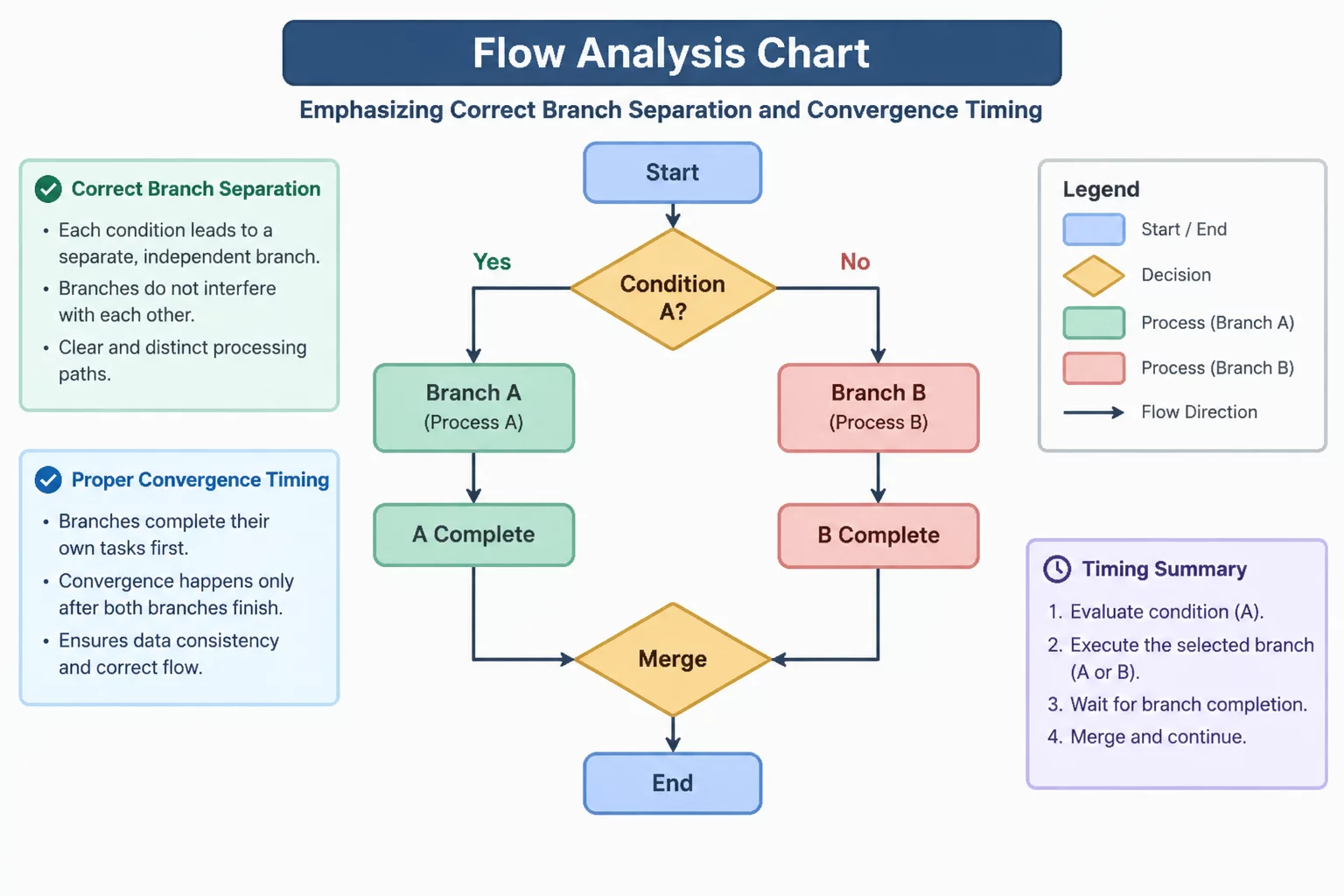
Why Workflow Branches Merge Prematurely
Diagram authors often rush to reconnect alternative branches into the main workflow stream. The primary motivation is usually visual neatness. A single outbound line heading toward the finish step makes the diagram look compact, yet this habit hides dangerous operational blind spots.
An alternative branch carries unique conditions, approvals, or operational constraints. Reconnecting this branch to the main sequence before resolving those differences causes downstream handlers to treat exceptions as normal cases. This introduces unmonitored failures into production systems.
Diagramming Decision Forks with Precision
Master node placement, decision diamond labels, and visual convergence rules in our dedicated draw.io guide.
Critical Dangers of Blended Branch States
Conflating distinct execution branches before finishing intermediate verification creates three acute organizational failure modes:
- Contextual attribute erasure: Specialty parameters such as risk ratings or high-touch handling flags get stripped or ignored by trunk handlers.
- SLA contamination: Fast-track or escalated scenarios prematurely assume routine schedules, causing compliance penalties and SLA breaches.
- Audit trail obscurity: Regulatory inspectors cannot ascertain whether an item satisfied standard validation or followed an undocumented override path.
"When diagram branches rejoin for aesthetic symmetry rather than business logic completion, the workflow conceals the very exceptions it was built to manage."Tony Stark, Process Architecture Specialist
Branch Convergence Verification Standards
Assess your workflow against these four structural criteria before adding a join connector back to the primary flow:
| Verification Step | Validation Requirement | Enforcement Level |
|---|---|---|
| Data Payload Symmetry | Ensure incoming data keys and status flags align with base requirements. | Strict |
| Role Reassignment | Hand off ownership explicitly before returning to shared pools. | Mandatory |
| SLA Re-anchoring | Recalculate turnaround timers to reflect diversion duration. | Required |
| Exception Terminal Split | Terminate terminal failure branches without returning to the happy path. | Critical |
Convergence FAQ
Look at the step immediately following the convergence point. If that step needs distinct inputs depending on which branch took it, the merge occurred too early.
Exception flows should only rejoin after explicit remediation steps restore the item to standard criteria. Terminal exceptions must lead to an independent end state.
Use distinct swimlanes and labeled gateway shapes to show where branches diverge, keeping lines separated until an audited join node synchronizes them.