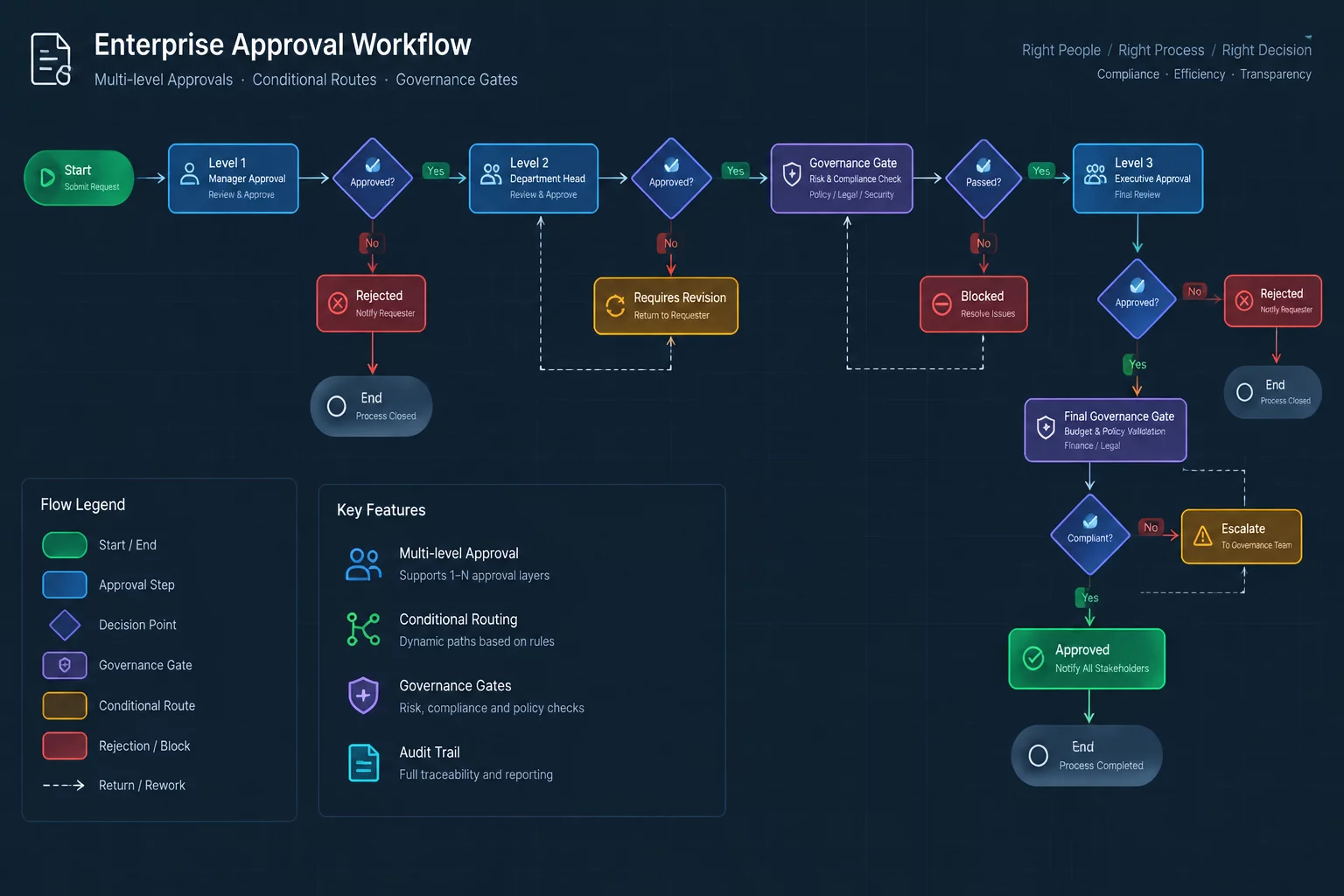
Decoupling Approval Gates from Sequential Execution
In high-throughput enterprise environments, workflows frequently deteriorate into unmonitored queues because approval checkpoints are drawn as mere rectangular steps labeled "Manager Signs Off". This design flaw obscures the underlying branching logic. An approval checkpoint is never an isolated action; it is a deterministic decision diamond producing distinct downstream states. When teams treat approvals as single-step activities, they fail to specify the handling mechanism for conditional deferrals, outright rejections, or policy conflicts.
To build dependable decision analystures, business analysts must isolate the assessment event from downstream work. A well-constructed gate specifies who possesses jurisdiction, the exact criteria that justify progression, and the alternative destination for cases that do not satisfy the baseline standard. Establishing clear boundaries prevents operational deadlock, enforces accountability during audits, and provides developers with an unambiguous state machine model.
Render Multi-Branch Approval Logic in draw.io
Examine step-by-step schematics and download reference templates for configuring multi-lane decision forks without layout fragmentation.
Hierarchical Escalations and Asynchronous Sign-Off Patterns
Real-world business rules rarely conform to a flat linear chain. Complex operations involve financial thresholds, risk classifications, regulatory compliance checks, and cross-departmental reviews. Effective workflow design segregates these responsibilities into discrete, measurable patterns:
- Tiered Value Matrices: Routing authority dynamically switches based on financial thresholds or risk indices, preventing senior managers from reviewing routine requests.
- Explicit Remand Pathways: Distinguishing hard denials from requests for revision, routing documentation back to the initiator with mandatory change markers.
- SLA-Driven Escalation Timers: Automated branch activation when a gatekeeper exceeds the assigned response window, preventing indefinite operational stagnation.
When an approval step is documented as a simple process rectangle instead of a decision fork, the diagram conceals what happens when someone says no.Uma Thurman, Principal Workflow Architect
Workflow Gate Specifications Matrix
Every workflow stage requires formal definition across authority level, permitted terminal states, and audit tracking requirements.
| Gate Type | Decision Rule & Criteria | Standard SLA |
|---|---|---|
| Operational Verification | Direct manager confirms submission completeness and regulatory adherence | 24 Hours |
| Financial Authorization | Department director validates budgetary allocation above standard threshold | 48 Hours |
| Compliance & Legal Review | Legal counsel reviews external contractual commitments and cross-border data transfer | 72 Hours |
| Executive Escalation | Executive committee evaluation for non-standard policy exceptions and high-risk variances | 5 Business Days |
Frequently Asked Questions
Standard process boxes imply single-input, single-output actions. An approval inherently creates multiple branches: approval, outright rejection, return for modification, or escalation. Modeling approval as a process box obscures alternate routes and creates unmonitored exception states.
Parallel sign-offs require an explicit synchronization node. Both paths must register verified completion before downstream execution begins. If either party rejects or requests modification, the entire batch must route to a predefined consolidation state rather than advancing halfway.
Incorporate an SLA timer diamond directly into the workflow model. When the timer expires without a decision event, the path automatically forks into an escalation lane or delegates temporary sign-off authority to a designated alternate.