Why Surface-Level Diagram Walkthroughs Fail
Casual workflow walkthroughs routinely focus on graphic layout and step sequences while overlooking hidden decision fallacies. Reviewers glance at diamond shapes and assume that labeled connectors cover real runtime realities. Production failures trace back directly to ambiguous branch conditions that leave operational staff guessing under high workload.
A rigorous decision review treats each fork as an isolated logical unit. The review board inspects incoming data payloads, interrogates the completeness of branch logic, and ensures that every fallback connector terminates in a valid resolution rather than an untracked dead end.
Connecting Reviews to draw.io Workflows
Learn how to encode custom metadata, decision ownership attributes, and condition formulas directly into external diagram layouts.
Critical Inspection Criteria for Decision Forks
Reviewers examine three key operational aspects to confirm that every branch operates with complete deterministic certainty:
- Mathematical Boundary Checking: Numerical and temporal conditions must leave no undefined gaps between outcomes, ensuring that boundary numbers map to exactly one outgoing branch.
- Direct Exception Attribution: Failure modes and timeout triggers require clear owner roles rather than generic system tags, preventing unmonitored ticket queues.
- Isolation of Compound Logic: Diagrams must split combined questions into sequential single-question diamonds, avoiding messy multi-way branches that obscure root causes.
An uninspected decision fork is an operational outage waiting for its trigger condition. Formal verification turns workflow diagrams into true engineering assets.Yara Greyjoy — Decision Architecture Specialist
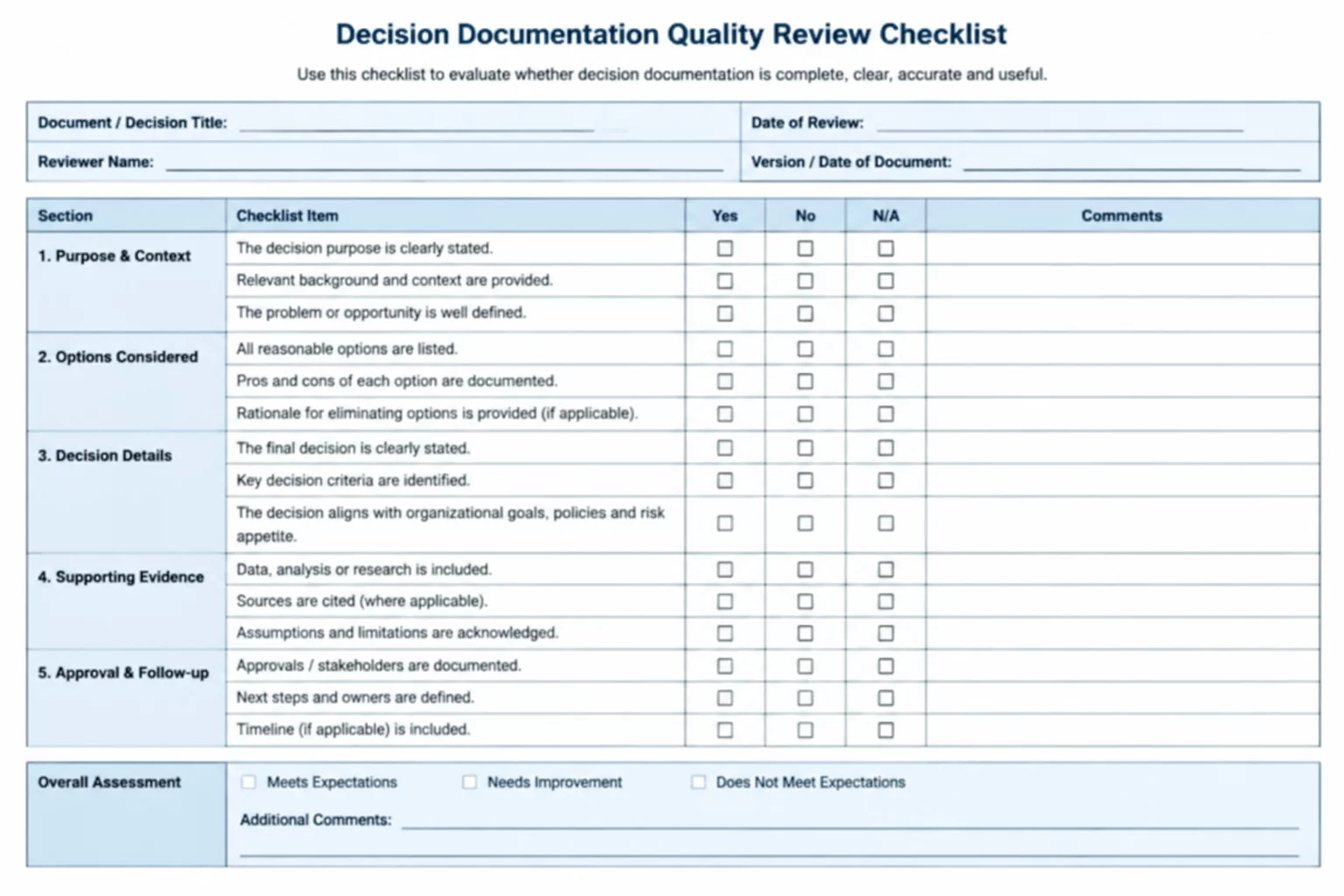
Decision Review Quality Matrix
Audit teams evaluate diagram quality across four structured tiers to determine deployment readiness.
| Verification Parameter | Validation Check | Acceptance Criteria |
|---|---|---|
| Branch Exhaustiveness | Assess whether all possible runtime combinations map to defined connectors | Zero Unhandled States |
| Condition Exclusivity | Verify that criteria rules never trigger two outbound paths simultaneously | Absolute Disjunction |
| Authority Ownership | Confirm an accountable job title is assigned to the decision node | 100% Named Roles |
| Convergence Integrity | Inspect rejoin points to ensure converging lines share matching state data | Identical Payload Schema |
Frequently Addressed Review Scenarios
Effective reviews require the diagram architect, a frontline operator who executes the workflow daily, and the designated business owner responsible for rule changes. This combination prevents theoretical designs from breaking under daily operational demands.
Diagrams must route edge cases into a dedicated fallback queue with explicit escalation parameters. Terminating unknown scenarios inside open process blocks hides systemic risk from audits.
Operational teams re-evaluate decision models every six months or immediately upon policy updates, system migrations, and audit findings. Regular inspection cycles catch workflow discrepancies before customer-facing issues occur.