Why Escalation Paths Break Standard Decision Flows
Operational teams frequently treat escalations as passive administrative notifications rather than formal decision bifurcations. When an automated timeout expires or an asset value surpasses first-line clearance limits, workflows often inject ambiguous side-loops that bypass compliance checkpoints. Without dedicated decision diamonds representing the handoff state, downstream operators inherit unresolved conditional baggage, resulting in untracked exceptions and process gridlock.
In robust operational diagrams, every escalation trigger functions as an explicit gateway. It captures the initial failure condition, locks the active transaction state, and generates a scoped decision boundary. By isolating the event from standard throughput channels, the organization prevents unvalidated assumptions from propagating into payment, fulfillment, or regulatory audit pipelines.
Build Clean Decision Diamonds in draw.io
Learn how to map explicit forks and avoid visual conflation in your process architecture.
Four Rules for Modeling Exception and Escalation Forks
Integrating escalation mechanisms into standard diagrams requires rigorous separation of concerns. Adhere to these core structural guidelines when drafting decision branches in your operational models:
- Define explicit timeout gates: Never let a pending state wait indefinitely without a terminating clock decision diamond that routes directly to tier-two remediation.
- Establish non-reversible handoff properties: Assign single-owner custody tags to escalated tokens to ensure the originating lane cannot concurrently manipulate payload records.
- Mandate distinct exit reconnects: Force escalated flows into a formal post-review rejoin node instead of merging them arbitrarily back into upstream input queues.
An escalation branch that re-enters a workflow without a validated reconciliation state is not an exception handler—it is an infinite loop disguised as governance.Victor Hugo, Lead Systems Architect
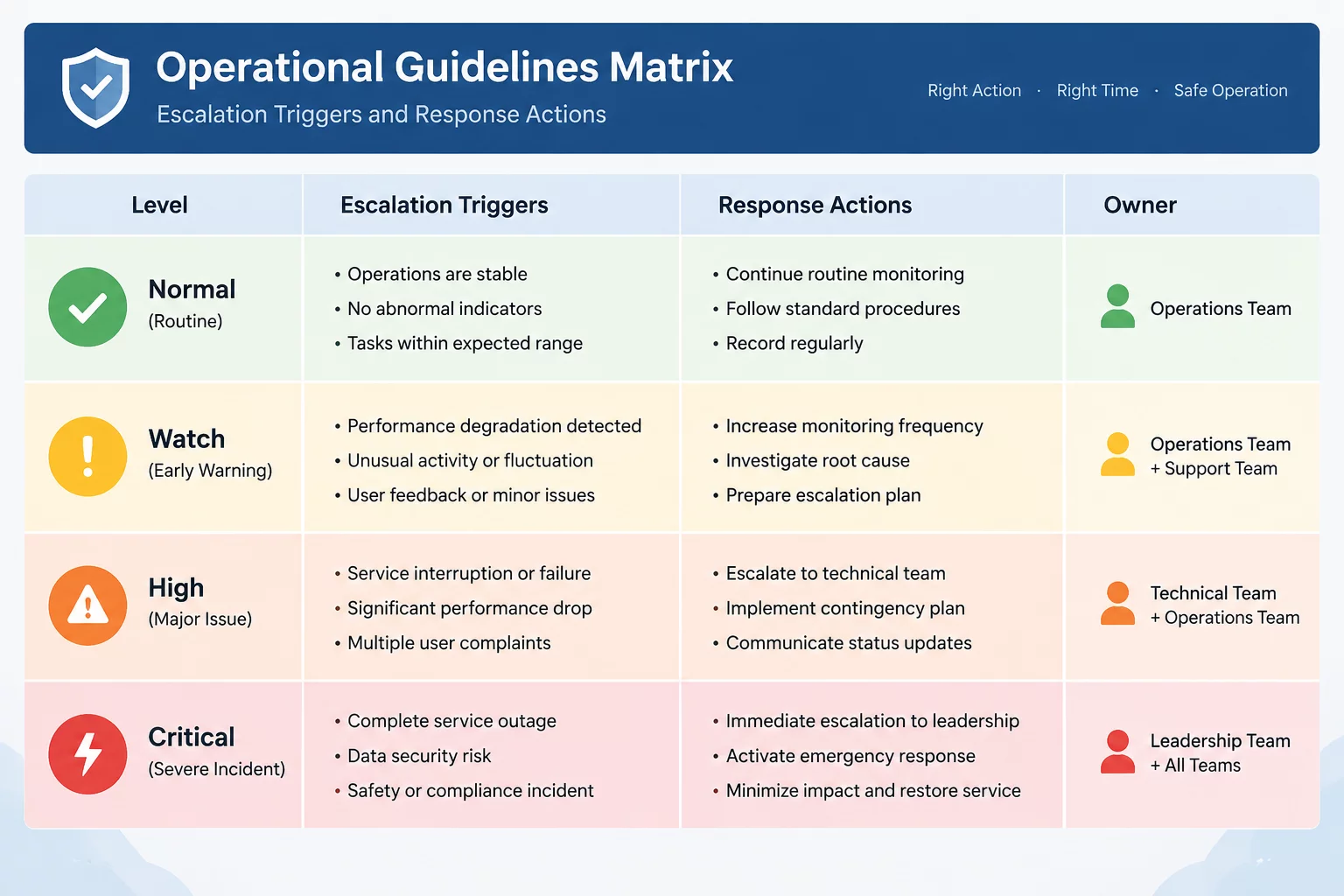
Escalation Trigger Classification & Handoff Criteria
Standardize branch behavior across departments by categorizing trigger parameters against defined operational thresholds, custody assignments, and audit tags.
| Trigger Condition | Architectural Consequence | Resolution Tier |
|---|---|---|
| SLA Timeout Exceeded (>48h) | Automates payload clone, suspends primary lane, and dispatches urgent supervisory dispatch. | Tier-2 Operations |
| Discretionary Limit Breach (>$50,000) | Bifurcates sequence into dual-signoff gateway requiring independent compliance review. | Executive Signoff |
| Validation Failure / Fraud Signal | Freezes transactional state, routes token to forensic isolation lane, and emits security telemetry. | Risk Compliance |
| Cross-Departmental Impasse | Triggers arbitration quorum fork, neutralizing parallel branch deadlocks via consensus protocol. | Governance Board |
Escalation Management Questions
Triggers must be evaluated inside decision diamonds because they test conditional thresholds (e.g., has SLA expired?). The subsequent notification or handoff task is a process box positioned immediately along the true outcome branch. Conflating the two conceals critical governance boundaries.
The escalation path must include a secondary decision diamond modeling rejection. Rejections should route to a terminal archive state or an explicit exception remedy lane, never directly back to intermediate stages without validation.
Introduce automated fallback diamonds with cascading timers. If a Tier-2 supervisor fails to acknowledge the escalated ticket within designated hours, the model executes a deterministic lateral handoff to a designated deputy.