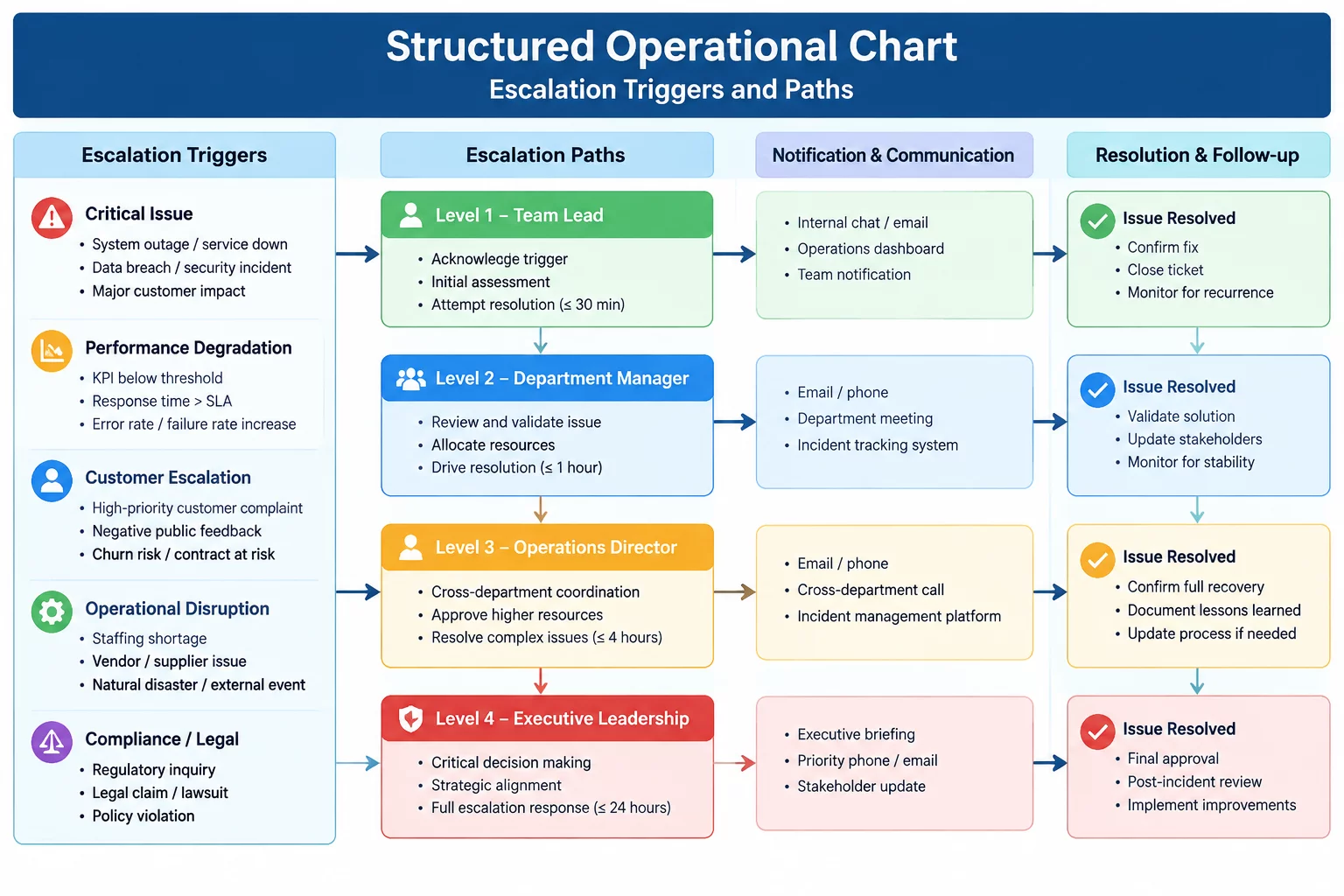
01Architecture of Multi-Tier Escalation Branches
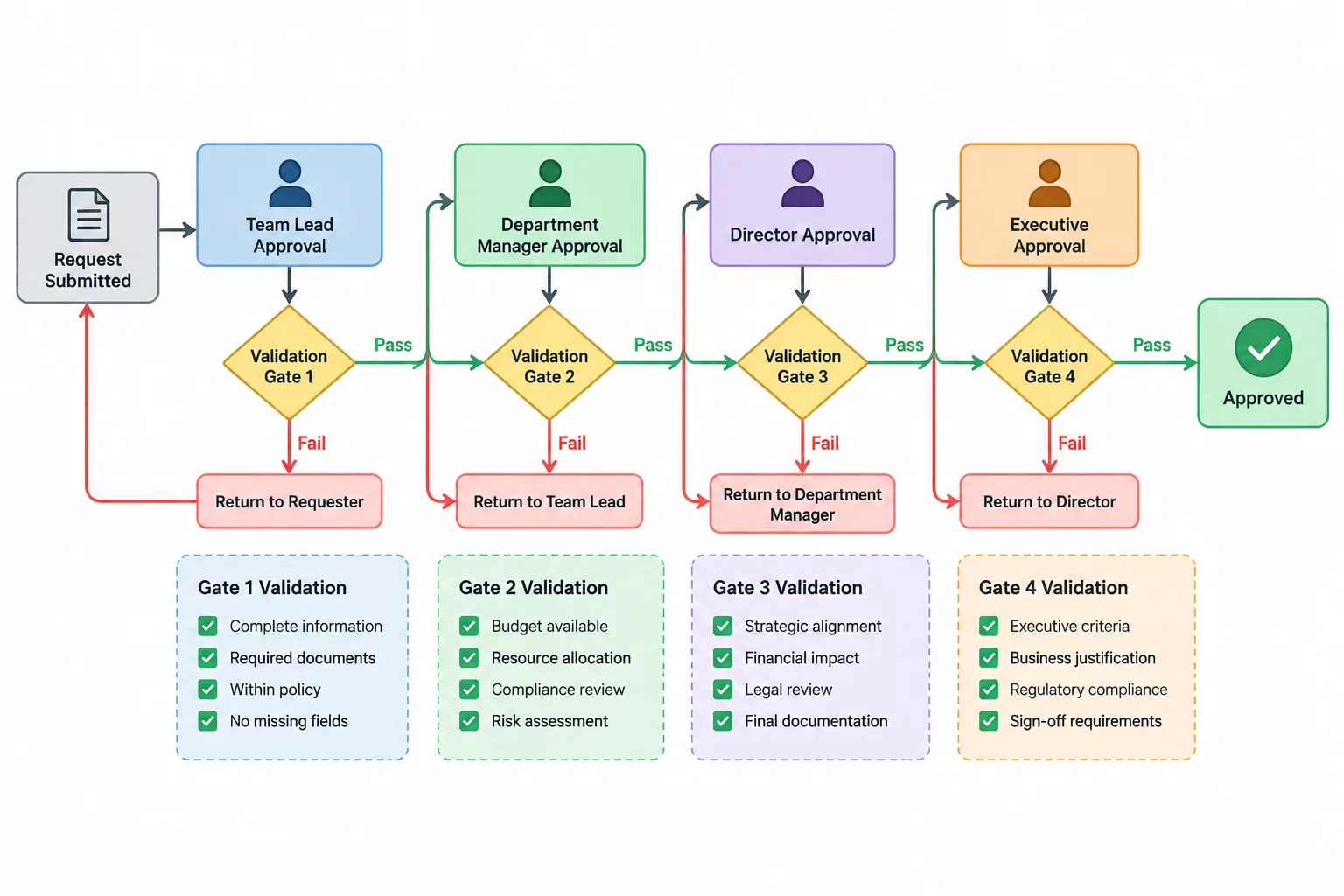
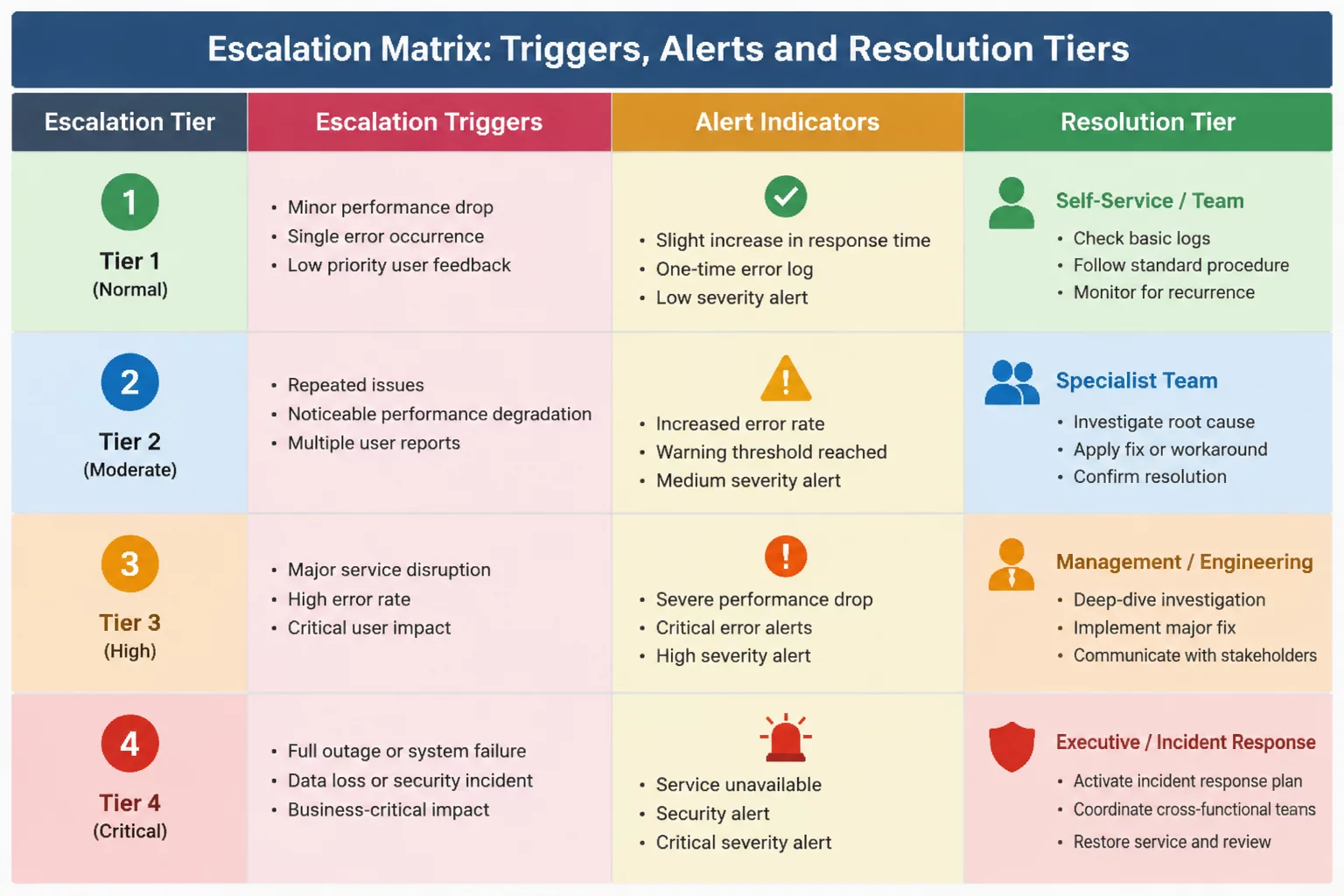
When operational transactions fail to satisfy normal execution parameters, processes must never stall in silent limbo. Escalation branches provide explicit deterministic paths that divert anomalous exceptions directly to accountable specialists or higher supervisory tiers.
Operational teams frequently assume that unresolved tickets or stalled items will naturally self-correct through routine email notifications or shared inbox monitoring. In practice, unhandled variance produces systemic stagnation. Our escalation model institutes precise mathematical thresholds based on elapsed queue duration, ticket severity tags, and transaction value indicators. Once an inbound record breaches a defined threshold window, execution flow branches out of standard queues into higher-tier handling pools.
Each divergence point requires explicit input conditions and unambiguous ownership handoffs. Rather than leaving escalation as an informal human decision, the workflow diagram formalizes the fork using standard decision diamond notation with discrete true-or-false validation gates:
- Threshold Evaluation Gates: Quantitative triggers based on elapsed dwell times, transaction volume limits, or client priority ratings.
- State Mutation and Ownership Handover: Immediate reallocation of operational accountability to designated escalation rosters with automated notification dispatches.
- SLA Clock Synchronization: Independent deadline tracking that prevents parent processes from hanging indefinitely while downstream investigations take place.
Key Operational Takeaways
Implementing rigorous escalation branches safeguards operational integrity and ensures SLA compliance under severe workload spikes:
- Map every escalation path with distinct entry criteria and measurable time bounds.
- Assign an explicit role custodian to every escalation fork rather than relying on shared distribution inboxes.
- Provide automated fallback actions for cases where escalation recipients fail to acknowledge items within SLA limits.
02Fail-Safe Traps and Stagnation Prevention
The most catastrophic flaw in workflow modeling is the infinite escalation loop. When second-tier teams encounter ambiguous requirements, they frequently bounce tickets horizontally or leave them unassigned. The escalation case architecture introduces a dead-letter custodian node that absorbs unresolvable edge cases after two unacknowledged transfers.
By enforcing single-direction progression through escalation tiers, the model prevents organizational ping-pong. Every escalation must resolve toward either expedited manual decision-making, conditional deferral with signed documentation, or formal executive termination.
An escalation without an explicit owner and a rigid timer is simply a delayed abandonment of operational responsibility.
Lead Operational Systems Architect
03Auditing and Traceability in Escalated Paths
Traceability must remain unbroken even when a process enters an emergency override channel. The escalation branches maintain detailed event logs documenting trigger timestamps, triggering factors, reassignment sequences, and subsequent approval chains. This deterministic record guarantees thorough post-incident retrospective fidelity.
Process intelligence systems ingest these transition events to flag chronic bottleneck areas. When specific decisions consistently trigger Tier-2 escalation, organizations can rework upstream validation rules rather than continuously managing preventable firefights.