The Anatomy of the Latent Quad-Fork
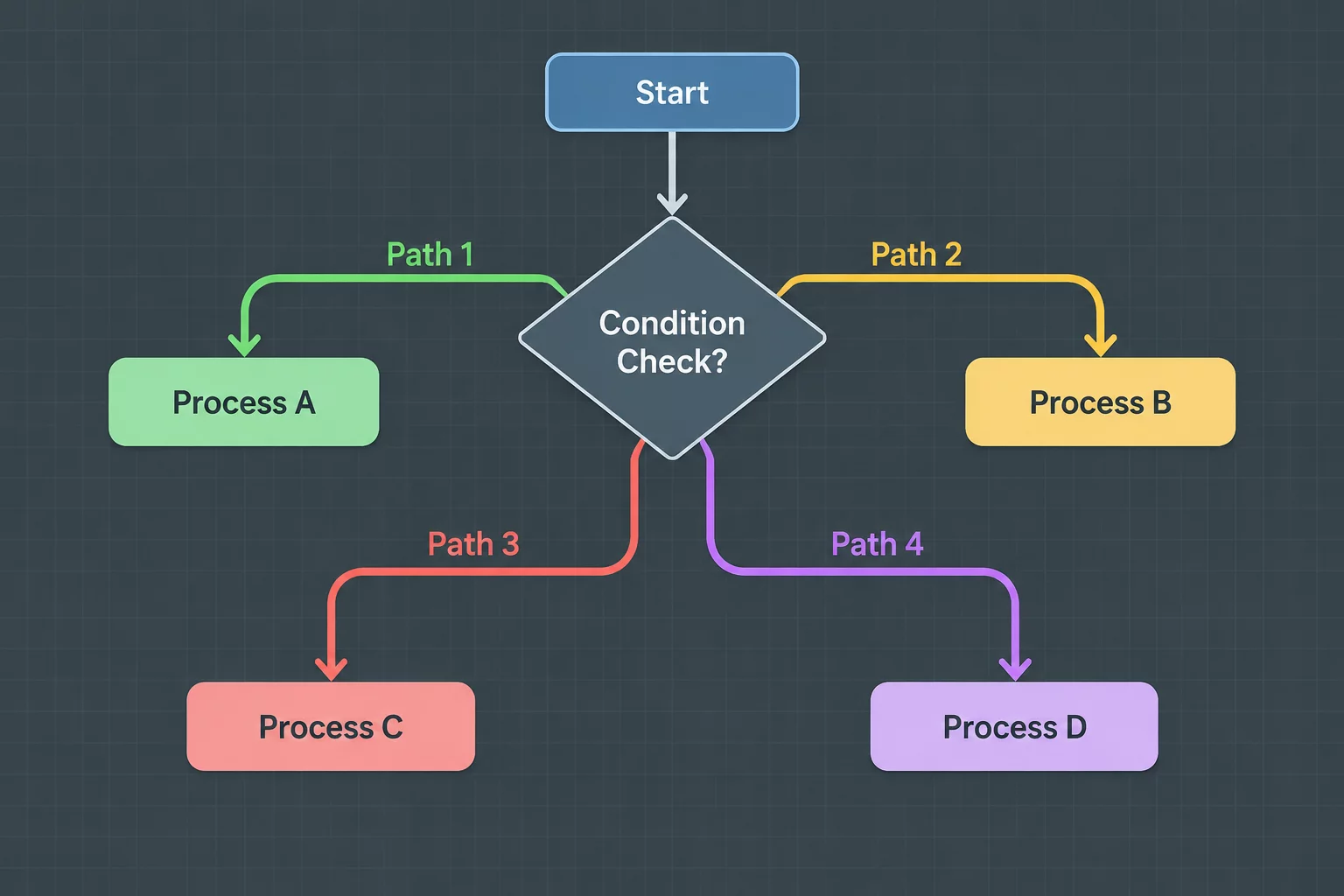
In high-throughput service desks and order-processing systems, analysts often condense compound conditions into a seemingly simple question. On paper, the diagram displayed a single diamond asking: "Is Customer Profile Verified?" with two outgoing connectors labeled "Yes" and "No". In operational practice, field representatives navigated four separate actions depending on whether the customer lacked documents entirely, submitted corrupted uploads, held partial verification status, or required elevated regional authorization.
Because the diagram failed to reflect these variations, agents improvised their own workarounds. Two branches handled standard clearance, while the third sent files to an unmonitored shared folder and the fourth silently bypassed secondary checks. This compression created immediate friction across operations, showing how a single binary question can accidentally trigger multiple unguided paths.
The system logged frequent drop-offs right at this verification step. Operations managers saw discrepancies between documented timelines and actual cycle duration, because operators routinely parked unresolved records in manual holding queues while attempting to deduce the proper route.
Where Binary Logic Deceives the Engine
A formal audit of the draw.io architecture revealed three hidden variables bundled into that single question. The diagram treated customer presence, document legibility, and compliance jurisdictional thresholds as one uniform state, creating widespread confusion throughout the pipeline:
- Path A (Verified and Low Risk): Auto-routes to instant account creation without manual intervention.
- Path B (Verified with Jurisdictional Flags): Diverts to compliance queue while retaining a misleading "Yes" status tag.
- Path C & D (Partial Rejection vs Fatal Absence): The "No" branch divided into re-request notices and immediate account freezes without documented criteria.
This layout proved unsustainable for automated audit trails. When an auditor inspected transaction records, they could not verify whether a rejection resulted from a systemic compliance violation or a routine timeout during identity upload.
Deconstructing Into Two Pure Gateways
To eliminate ambiguity, we replaced the single compound gateway with an explicit sequential evaluation pattern. The first diamond tests raw document completeness, establishing a clean binary outcome. If documentation exists, the token advances to an eligibility decision node that checks risk tiers and regulatory constraints.
By structuring the workflow this way, each path receives dedicated error codes, explicit lane assignments, and unambiguous SLA metrics. Operations teams no longer need to interpret hidden notes, and processing latency dropped significantly within the first reporting week.
Governance Standards for draw.io Models
Preventing latent multi-paths requires rigorous review standards during diagram sign-off. Process engineers must check that every exit connector matches a clearly defined schema property. If an engineer notes that an edge behaves differently based on secondary factors, the gateway must be separated immediately.
Our governance framework mandates that branch labels avoid vague terms such as "Exception" or "Manual Case". Connectors must specify the exact evaluating variable, keeping documentation completely aligned with operational realities.