The Anatomy of an Early Rejoin
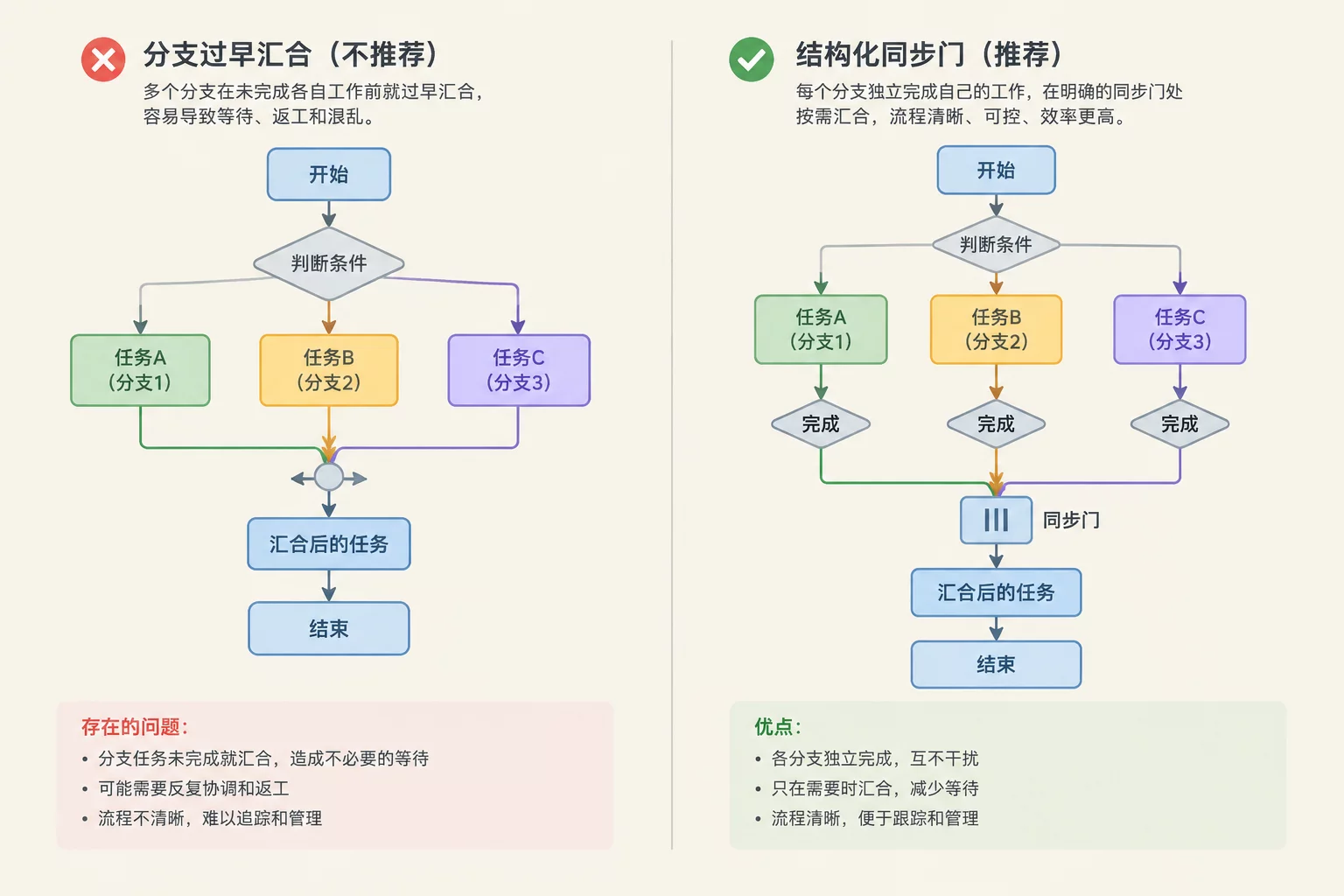
In complex enterprise operations, diagram designers frequently attempt to preserve visual neatness by merging diverging paths into a single sequence connector as soon as an immediate activity concludes. This aesthetic shortcut bypasses the fundamental reality of state mutations. When path A requires standard verification while path B handles a high-risk secondary appraisal, joining both streams back into a shared step like “Dispatch Notification” before confirming path B’s clearance creates a dangerous structural vulnerability.
Diagrams communicate execution contracts to development teams, auditors, and frontline operators. A path rejoining too early instructs the operational unit to proceed into subsequent stages regardless of whether the branch-specific validation ever finished. What looks like clean line routing on canvas manifests as critical bypass vulnerabilities inside real-world systems.
Process analysts often mistake cosmetic simplicity for procedural elegance. Compressing five steps into one shared inbound arrow masks conditional branches, misleading software engineers during workflow implementation and preventing automated systems from validating necessary intermediate flags.
Operational Hazards and Premature State Merging
When workflow topologies allow parallel or alternative flows to reconverge prematurely, distinct business failures follow a consistent sequence of errors:
- Missing Execution Preconditions: Subsequent processing assumes all antecedent validations reached positive resolution, even if an asynchronous exception route triggered the rejoin.
- Indeterminate State Collisions: Systems record contradictory payload records because intermediate variables generated along one branch overwrite or omit values needed by the other.
- Audit Trail Obfuscation: Compliance inspectors cannot reconstruct whether a record followed the expedited lane or the thorough inspection path once both share identical downstream nodes.
In high-throughput environments such as payment settlement or regulatory reporting, these topology errors cause manual intervention backlogs. Teams spend days diagnosing failed transactions because the process blueprint never formally isolated conditional requirements before rejoining.
Architectural Reconfiguration and Invariant Barriers
Eliminating premature convergence demands explicit join criteria. Rather than pulling disparate arrows directly into the next process node, analysts must introduce synchronization points or maintain branch separation until all terminal states align.
When alternative paths achieve genuinely different business outcomes, they must terminate in distinct end states rather than being artificially funneled back into the primary baseline. Clear divergence prevents false continuity and ensures downstream consumers receive predictable payloads.
Systemic Governance and Diagram Verification
Preventing topology flaws across enterprise diagram libraries requires rigorous modeling standards. Teams should apply systematic structural reviews before releasing diagrams into operational documentation or engineering sprints.
Conduct topology walkthroughs by tracing each incoming path backward from every convergence connector. If two converging paths carry incompatible preconditions or differing state guarantees, split the convergence node immediately. Enforcing this simple inspection protocol safeguards workflows against premature rejoining defects.